
Lawrence County Court Records After a Jail Arrest
After an arrest in Lawrence County, a person is booked into the jail, but the formal court record does not exist yet. It begins when the State's Attorney files a charging document that opens a case with the circuit clerk. From that point the court record tracks the charges, court dates, bond terms, and the final outcome. That record is separate from the booking. The jail roster shows the arrest charges; the court file shows the charges the prosecutor actually pursues, which can be amended, reduced, or dropped as the case moves.
It helps to keep the two sides apart. For the booking and custody side, the Lawrence County jail inmate records page covers the roster, and the jail mugshots page covers the booking photo. This page is about what happens next: the court records that follow an arrest, who keeps them, and how to read the charges once a case is open.
How to Find Lawrence County Court Records After an Arrest
Lawrence County court records run through the circuit clerk, who files and maintains every criminal, traffic, and civil case heard in the county. The clerk points the public to Judici, an online court portal, for court dates, balances, and case information. The Lawrence County court code on Judici is IL051015J, and you can search by a defendant's name or by a case number.
- Open the Lawrence County Judici case search from the circuit clerk's page or directly.
- Choose to search by name or by case number; for a name use last name, first name, then middle initial.
- Open the matching case and read the charge list, which is the court record after the arrest.
- Check each charge for its code, level, and current status across the case tabs.
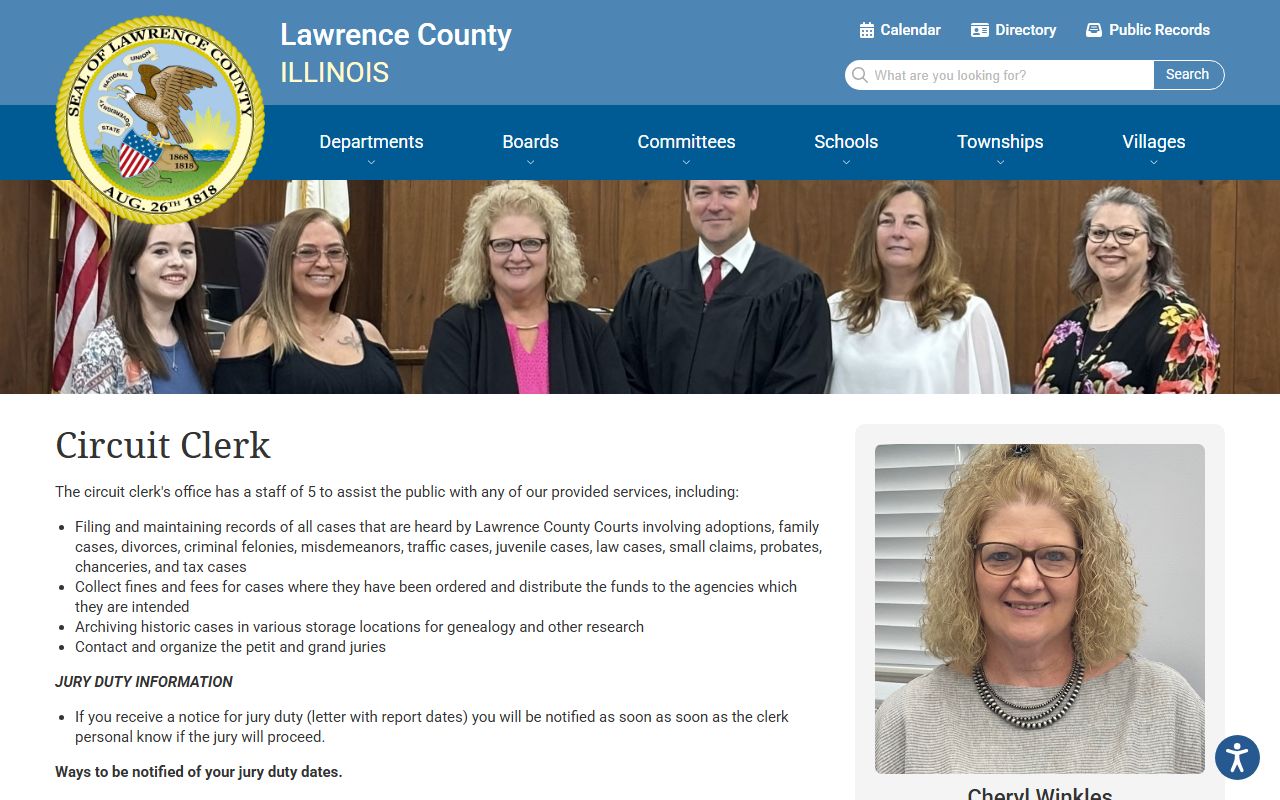
The circuit clerk's page, shown below, is the official starting point and links Judici alongside office hours and copy information.
You can reach it through the Lawrence County Circuit Clerk page, which carries the Judici link and the clerk's contact detail.
For a statewide criminal-history transcript rather than a single case, the Illinois State Police Bureau of Identification handles record requests and challenges, which is the route when a case spans more than one county.
How Charges Get Filed After a Lawrence County Arrest
The court record begins with a charging document. After the booking, the prosecutor decides what to file, and the form of that filing depends on how serious the offense is. Three main types start a criminal case, and the table sets them side by side.
| Complaint | Information | Indictment | |
|---|---|---|---|
| Filed By | Officer or prosecutor | State's Attorney | Grand jury |
| Common For | Misdemeanors | Many felonies | Serious felonies |
| Starts | The case | The case | The case |
Whichever document is filed, it is the moment the booking turns into a court record. From there the case number follows the matter through every hearing, and that number is the fastest way to pull the file later.
Charge Status in the Court Record
Charges are not fixed once a case opens. As it moves, a charge can be amended, reduced, added, or dropped, and the booking charges on the jail roster often differ from the charges the prosecutor finally files. Reading the status terms keeps you from mistaking an early accusation for a final result.
| Status | What It Means |
|---|---|
| Pending | The charge is filed and the case is still open, with no final outcome yet. |
| Amended / Reduced | The prosecutor changed the charge, often to a lesser offense. |
| Dismissed | The charge was dropped and is no longer being pursued. |
| Nolle Prosequi | The prosecutor formally chose not to proceed on the charge. |
On Judici, the case usually breaks out into tabs for information, history, dispositions, and payments, so the current status of each charge and any balance owed appear in one place.
The State's Attorney's Role
Illinois uses the title State's Attorney rather than district attorney. In Lawrence County the State's Attorney is the prosecuting authority that decides which charges to file and pursue after an arrest. The office works from the courthouse in Lawrenceville. The booking charges entered at the jail are the police view of the arrest, while the State's Attorney's filed charges are what the court record actually carries forward.
The State's Attorney is not the keeper of court copies, and is not the custodian of jail booking records. Copies of the court file come from the circuit clerk, and booking records come from the sheriff. Keeping those roles straight saves a wasted phone call when you are chasing a specific document.
Bond and Release After an Arrest
How a person is released after a Lawrence County arrest changed with statewide bail reform. The Pretrial Fairness Act took effect in September 2023 and ended routine money bond as the gatekeeper for new cases. Instead, a judge decides release or detention at a hearing under the state pretrial detention statute. For some older cases, warrants, or court-ordered amounts, a monetary bond can still apply, and the sheriff keeps day-or-night bond-payment instructions for those situations.
When a money bond does apply, the sheriff's corrections department accepts exact cash, a certified check payable to the circuit clerk, or a major credit or debit card, but never a personal check. A bond payment may not free someone if another warrant, a hold for another agency, or a detainer is in place, so confirm custody before paying. Common release paths break down this way:
- Pretrial release with conditions - the court releases the person under rules set at the hearing rather than a cash amount.
- Cash or certified-check bond - used where a monetary amount still applies; exact cash is required at the jail.
- Credit or debit card bond - accepted with a handling fee and can be paid remotely by phone.
- Held after a detention hearing - the court may order a person held when the law allows it.
Note: Because a current case may need a court decision rather than a payment, call the jail or the circuit clerk before trying to post money on a new arrest.
Warrants That Lead to an Arrest
Many Lawrence County bookings start with a warrant. The sheriff publishes a current warrants list, and the page tells anyone who finds their name to call the circuit clerk to learn what is owed and how to clear it. A warrant can turn into a fresh booking on the jail roster the moment the person is taken into custody, which ties the warrant list and the inmate roster together.
Warrant entries show a name, age, city, a case number, and a charge such as failure to appear or an order to take into custody. Those case numbers are the same identifiers you can drop into Judici to pull the underlying court record after an arrest. To clear a warrant, the circuit clerk at (618) 943-2815 is the office to call, since the warrant lives with the court even though the sheriff lists it.
Copies, Fees, and Courthouse Access
When you need a paper copy of a court record after an arrest, the circuit clerk is the office that provides it, and the clerk's FAQ notes that most records are available for a small fee. The clerk's office sits on the second floor of the courthouse and keeps regular weekday hours. The Illinois Courts profile also notes a public access terminal at the clerk counter with a printer and scanner for public use, which helps if you would rather pull a record in person than online.
Lawrence County Circuit Clerk
1100 State Street, Second Floor
Lawrenceville, IL 62439
(618) 943-2815
Monday-Friday 8 a.m. to 4 p.m.
Court fines and balances are handled separately from jail bond. The clerk directs payments through Courtmoney using case-type codes, so a fine or a court balance is paid to the clerk rather than the sheriff. Keep that split in mind, since the jail handles bond and the clerk handles court money.
Charges vs. Convictions in Lawrence County Court Records
Being arrested and charged is not the same as being convicted. A charge is an accusation that opens a case; a conviction is the outcome after a plea or a verdict. Court records show both stages, so read them with the difference in mind.
| Charge | Conviction | |
|---|---|---|
| Stage | Accusation | Verdict or plea |
| Burden of Proof | Probable cause | Beyond a reasonable doubt |
| Public Record | Yes | Yes |
A booking charge on the jail roster carries the least weight of all, because the prosecutor may never file it. Always check the court file before treating any arrest charge as settled.
Sealed vs. Expunged Court Records
After a dismissal or an eligible outcome, an Illinois record can sometimes be sealed or expunged. The two are not the same, and eligibility is set by state law and confirmed through the circuit clerk. The comparison below shows the practical difference.
| Sealed | Expunged | |
|---|---|---|
| Visibility | Hidden from most public view | Destroyed or treated as if it never existed |
| Law Enforcement | Limited access remains | Very limited access |
| Eligibility | Set by Illinois law; confirm with the circuit clerk | Set by Illinois law; confirm with the circuit clerk |
Sealing or expunging a court record can also be the proper route to take a booking photo out of public view, which the jail mugshots page covers in more detail.
Restricted Court Records After an Arrest in Lawrence County
Not every record after an arrest is open. Illinois treats juvenile law-enforcement and court records differently from adult cases, and those files are largely shielded from public search. Sealed and expunged matters drop out of public view, ongoing investigations can be withheld, and certain personal details are redacted even in open cases under the state's public-records exemptions.
Important: This site is not a consumer reporting agency, and court records found here may not be used for employment, housing, credit, or other FCRA-covered screening.